
If you have been dealing with Achilles tendinopathy, you have probably tried something that did not work. Rest. Ice. Stretching. Some generic calf raises someone found on YouTube. And then you went back to training too soon, it flared up again, and now you are in a cycle you cannot seem to break.
That cycle is not a you problem. It is a protocol problem, compounded by a mindset problem, made worse by being in the wrong environment for the kind of recovery this injury actually demands.
This is a breakdown of what initial stage Achilles tendinopathy treatment actually looks like, what the research supports, and what I tell every athlete and active person who walks into our clinic in Vero Beach struggling with this exact issue.
What Is Achilles Tendinopathy and Why Is It So Hard to Treat?
Achilles tendinopathy is not a simple inflammation problem. That is one of the most important things to understand. The traditional RICE approach was designed for acute injuries. Tendinopathy is a chronic degenerative condition where the tendon structure has changed over time due to overload without adequate recovery.
The tendon has not snapped. It has degraded. The collagen fibers are disorganized. The tissue has poor vascularity. And the nervous system has become sensitized to loading that it previously handled without issue.
This is why:
• Rest alone does not fix it. The tendon needs specific, progressive loading to reorganize.
• Generic calf raises often make it worse. The wrong stimulus at the wrong time reloads a tissue that is not ready.
• It has ups and downs with no obvious cause. Stress, sleep, training load changes all affect pain sensitivity independently of whether the tendon is structurally improving.
For chronic cases, defined as three months or longer, full tendon remodeling can take up to a year and a half. That is not a typo. This is a long process, and understanding that upfront changes everything about how you approach it.
Why Isometrics Work for Achilles Tendinopathy
Isometric loading, holding a contraction without movement through a range, does something specific to the tendon that eccentric exercises alone do not.
They create tendon creep. When you sustain a load through the tendon over time, you direct force into the tissue in a way that stimulates collagen reorganization and tendon remodeling.
They trigger a pain inhibition response in the nervous system. There is a well-documented analgesic effect from sustained isometric contractions that can reduce tendon pain for hours after a session. For athletes who cannot train through pain, this window is critical.
They build rate of force development without impact. The tendon needs to be able to generate and absorb force quickly when you return to sport or activity. Isometrics lay the neural foundation for that without adding the stress of running, jumping, or pushing off.
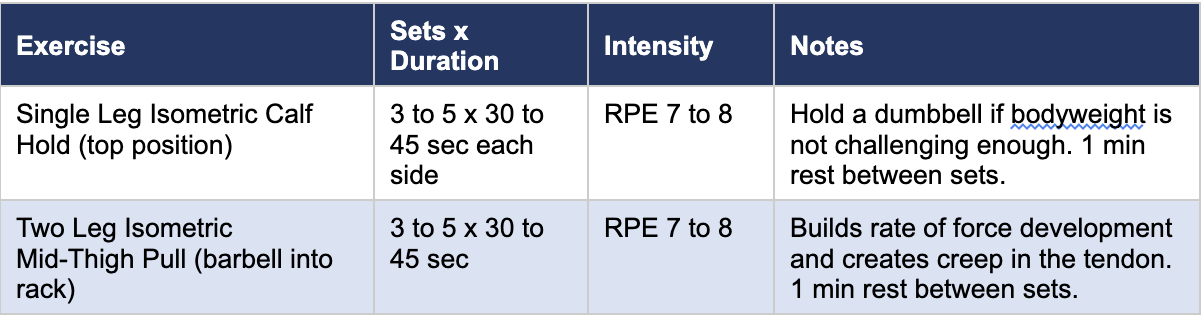
The key variables are time under tension, 30 to 45 seconds per set, and intensity, RPE 7 to 8. Too easy and you do not get the stimulus. Too hard and you exceed what the tissue can currently tolerate.
The Initial Stage Achilles Tendinopathy Isometric Protocol
Before you start: the 3 out of 10 rule. Every exercise in this session must stay at or below a 3 out of 10 on a pain scale. Dull and achy is acceptable. Sharp is not. If you can breathe through it, talk through it, and it fades within a reasonable window after the set, you are in the right range.
Warm Up
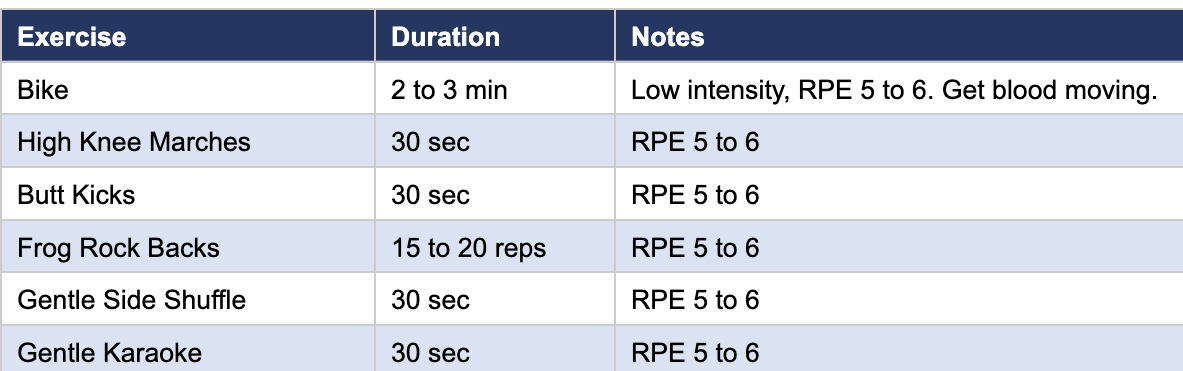
No rest between exercises. The goal is blood flow and nervous system preparation.
Hip Activation: Motor Control for Single Leg

Achilles tendinopathy almost always involves a single leg stability and hip control issue up the chain. If the hip and glute are not doing their job, the Achilles compensates. This section addresses that directly.
Achilles Isometric Protocol
Movement Based Fitness: Achilles Safe
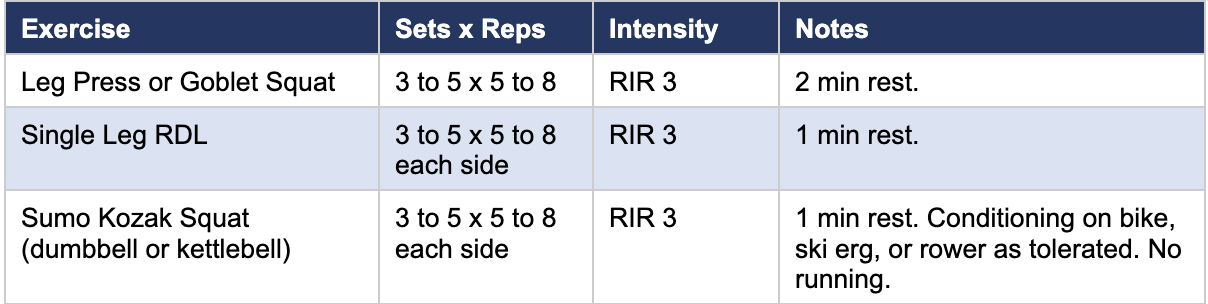
This section keeps you fit without stressing the Achilles. These movements are not contraindicated and allow you to maintain strength and conditioning while the tendon heals.
The Part Nobody Talks About: Mindset and the Ups and Downs
Here is something I tell every patient with tendinopathy in the first session: there will be a day, two or three months in, where you have been making great progress and suddenly things feel like they went backward. Sleep was bad. Stress was high. Life happened. And your pain sensitivity went back up.
That is not a setback. That is a nervous system doing what nervous systems do under load.
The mistake most people make is letting that one bad day derail the whole process. They skip sessions. They second-guess the program. They lose momentum that took months to build. And then they wonder why their recovery stalled.
What I preach here, and what performance coaches working with Olympic athletes will tell you, is a simple principle: control what you can control.
You cannot control every variable that affects your pain. You can control whether you show up. Whether you do your program. Whether you prioritize sleep and nutrition. Whether you stay consistent on the bad days.
One bad day does not undo good work. Two bad days does not either. What matters is the overall trajectory, and the only way to protect that trajectory is to stay in the process when it gets uncomfortable.
This is where traditional physical therapy fails most patients. The focus is entirely on pain as a metric. Pain goes up, change something. Pain goes down, keep going. There is no coaching around how to think through the hard weeks, how to interpret a flare-up, how to stay consistent when progress is not linear. We build that education into every program at Hercules from day one because it is not optional. It is a core part of the outcome.
Why Your Environment Determines Your Long-Term Outcome
You are the product of the environment you put yourself in. That is true in sports, in business, and it is absolutely true in rehab.
If you are in an environment that never asks what you are training for, never pushes past the goal of getting you out of pain, and has no long-term plan for where you go after six weeks, that environment will shape what you believe is possible.
The environment you need for a full recovery from something like Achilles tendinopathy looks like this: a facility with real equipment, weight room access, turf, and tools to actually measure your progress. Clinicians who have played sports, who understand what return to activity actually demands, and who are not satisfied with “you feel better” as a finish line. A team structure where you are supported beyond your one-on-one session. And a program that exists after the acute phase is over, that takes you from out of pain to actually performing.
At Hercules Performance & Physical Therapy in Vero Beach, our DPTs hold CSCS certifications. That combination of clinical training and strength and conditioning expertise is not common, and it matters specifically for injuries like this where the gap between pain-free and performance-ready is significant.
If you are three months into Achilles tendinopathy, still in pain, and not sure why things are not progressing, the first question to ask is whether the environment and the protocol are actually built for what you need.
Frequently Asked Questions About Achilles Tendinopathy
How long does it take to recover from Achilles tendinopathy? Acute cases with proper loading protocols can see significant improvement in 8 to 12 weeks. Chronic cases, defined as symptoms lasting more than three months, may require six months to a year or longer for full tendon remodeling. The key is consistent progressive loading, not rest.
Should I stop running with Achilles tendinopathy? In the initial stage, yes. Running is an impact sport and the Achilles cannot tolerate that load until it has been properly prepared. Conditioning can continue on a bike, ski erg, or rower. As strength and pain tolerance improve, return to running is introduced gradually.
Are isometrics better than eccentric exercises for Achilles tendinopathy? Both have research support. Isometrics are particularly useful in the initial stage because of their analgesic effect on the nervous system and their ability to load the tendon without range of motion stress. Eccentric and heavy slow resistance protocols are introduced as the tendon tolerates more load.
What makes Achilles tendinopathy worse? Sudden spikes in training load, inadequate recovery, poor sleep, high stress, and inappropriate loading are the most common drivers. The tendon needs progressive, well-managed load, not rest followed by sudden return.
Is Achilles tendinopathy the same as an Achilles tear? No. Tendinopathy is a degenerative condition in an intact tendon. A tear or rupture is structural damage. The treatment approaches are very different. If you have sudden, severe pain and loss of function, that requires immediate evaluation.
The Bottom Line
Achilles tendinopathy recovery is not complicated, but it requires the right protocol, the right mindset, and the right environment. The isometric protocol described here is a starting point for the initial stage. It is not the whole program.
If you are dealing with Achilles pain and want a plan built around your specific situation, your activity goals, and where you actually want to get back to, that is exactly what we do at Hercules Performance & Physical Therapy in Vero Beach, Florida.
Schedule a free 15-minute Discovery Call to talk through what is going on and whether we are the right fit for where you want to go.
